🚀 BARF — how to get started?

Discover the principles of the BARF diet. Find out what biologically appropriate nutrition for dogs and cats entails, how to switch to BARF step by step, how to balance meals, and what supplements you’ll need. Practical advice, checklists and support for new pet owners.
🤔 Who is this diet for?
BARF (Biologically Appropriate Raw Food) is a method of feeding pets based on raw meals balanced according to scientific guidelines that meet their natural needs. An alternative is BACF — the cooked version.
Key principles of BARF/BACF:
- 🥩 Meat and offal. The diet is based on animal-derived products. Both cats and dogs need these for their health and vitality.
- ⚖️ Balanced supplementation. Carefully selected supplements provide a complete range of essential nutrients.
- 🚫 No grains or artificial additives. With BARF, you decide what goes on your pet’s plate. No grains, sugar, colourings or thickeners — just pure ingredients.
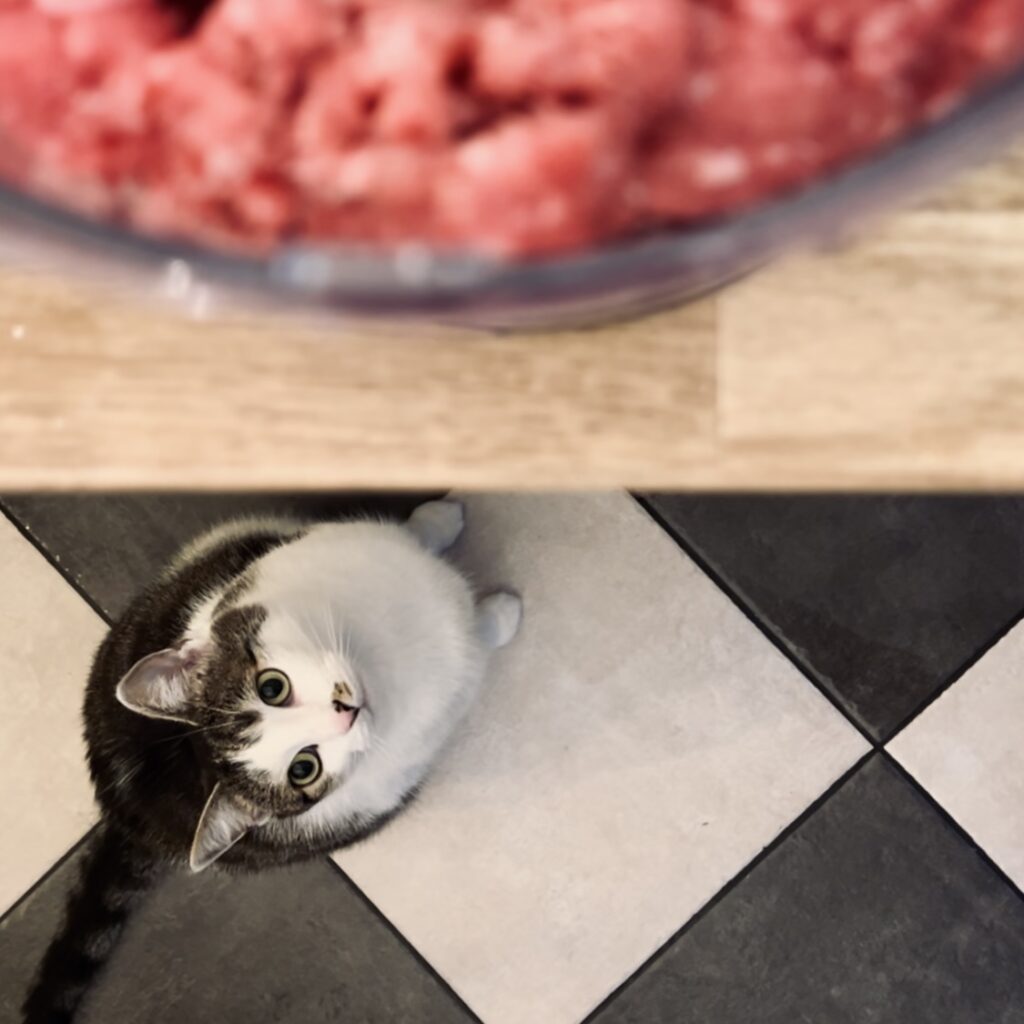
🤨 Why is it worth it?
- ✨ BARF delivers tangible health benefits: a glossy coat, more energy, reduced susceptibility to illness, and fewer digestive problems and allergies. In the long term, this means fewer illnesses and lower veterinary bills.
- 🧪 Preparing BARF yourself means you have full control over quality. You use fresh, human-grade ingredients, free from preservatives, thickeners and flavour enhancers.
- 🥩 Unlike highly processed foods, BARF is a fresh and natural diet. You avoid harmful heat treatment, preservatives and industrial additives, which can lead to inflammation and metabolic diseases.
- 🤑 BARF saves you money: the monthly cost for a 5 kg cat is around EUR 30–40, whereas premium dry food costs EUR 50-80.
- 🚀 Preparing BARF for a small pet takes 2–3 hours a month: an hour for shopping, an hour or two for portioning. No time spent reading labels, testing different foods and flavours, or visiting vets for health issues that you can now easily avoid.
☺️ Carers’ stories: results in practice
“After switching to the cooked version of BARF, Rocky stopped scratching, his allergies disappeared, and his coat became glossy. It wasn’t easy at first, but the results are well worth it.”
“Lucky switched to BARF after years of dietary mistakes and weight issues. Now he’s full of energy, doesn’t beg for food, and has excellent test results. The Meatpoint.io calculator has proved to be an indispensable tool!”
“I feed my whole cat squad cooked meals from Meatpoint.io and I have no intention of going back to tins. Everything disappears from their bowls, the cats have more energy, and I know exactly what’s going into their bowls.”
🍽️ How does BARF feeding work in practice?
🐈⬛ BARF for cats is a bit like a salad. Except that it consists of meat, offal, supplements and, optionally, vegetables, all mixed together according to a recipe. You prepare it once a week or fortnight, portion it out (1 day = 1 portion) and freeze it. Every day, you defrost one daily portion and serve it to your cat in several meals (ideally 5–6).
🐕 BARF for dogs can take various forms. It can look like a dinner set – with meat and vegetables – or like a filling for croquettes. You choose the form depending on your dog’s and your own preferences. The principle is the same – you prepare it once every few days or weeks, freeze it (1 day = 1 portion) and serve it daily. If you opt for croquette filling, mix the meat, offal, vegetables and fruit, stir in the supplements with water, and it’s ready to freeze
If you decide to go for a set meal, bear in mind a few rules:
- the recipe should be evenly distributed across each day, e.g. approx. 1/3 meat, 1/3 offal and 1/3 vegetables (if included in the recipe) per day. If your dog eats everything with gusto and doesn’t pick and choose, e.g. just the liver, then the balance of the mix is maintained :)
- Additionally, if you’ve included fruit or treats in the diet, try to distribute them as evenly as possible — you want to avoid a situation where your dog eats only the treats and has no room left for ‘dinner’ :)
- This method usually involves giving ‘supplement treats’ or ‘supplement portions’ — that is, a daily dose of supplements in the form of a frozen biscuit. In the recipe, you blend the supplements with something tasty (also from the recipe), e.g. liver or egg yolks, freeze them in moulds, planning one piece per day, and serve them with the main meal.
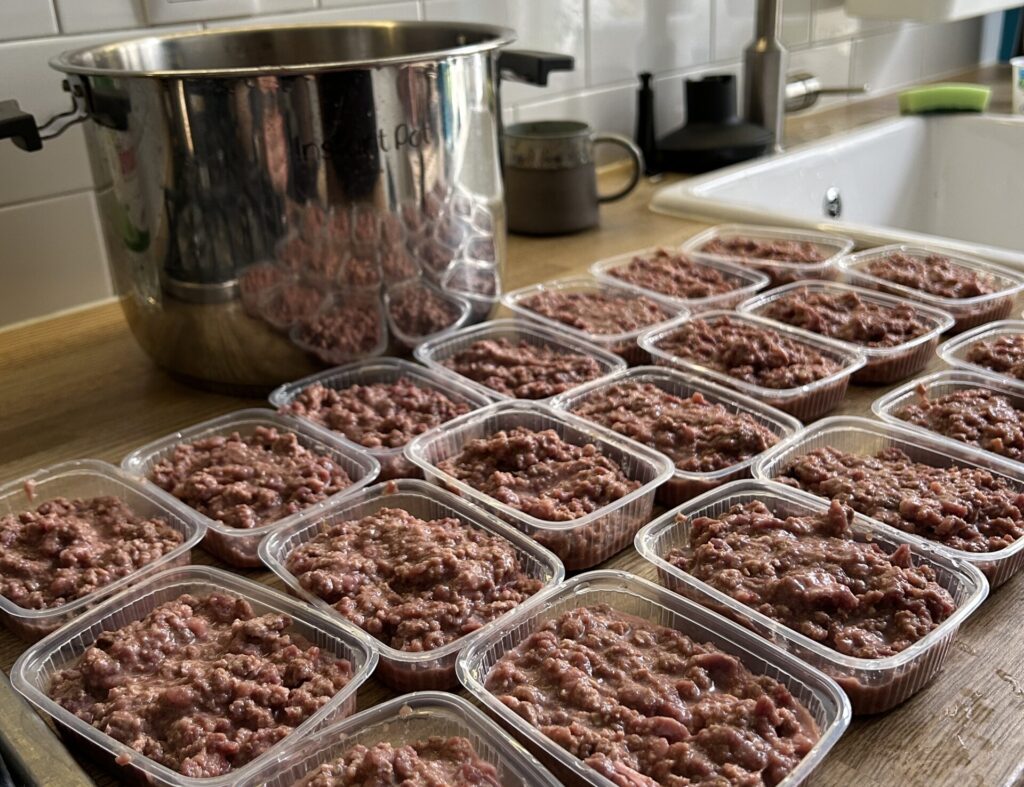
🥩 BARF step by step — because you eat an elephant one bite at a time
- 🐈⬛ 🐕 Get yourself ready — this step is often overlooked, yet it’s probably the most important one. You’ve decided to feed your pet a healthier diet, and the success of this mission depends on you!
- 🐈⬛ 🐕 Prepare your pet — visit the vet and have your dog or cat checked over. If they’re healthy, you can move on. It’s worth checking your pet’s health regularly — regardless of what they’re fed. Preventive check-ups are like an annual service, giving you peace of mind that everything’s fine. This means that when you decide to switch to a BARF diet, you can be sure your pet is starting with a clean slate, and any changes in their well-being will be clear and easy to spot – without any unnecessary guesswork ? ?
What tests are worth doing and why? You’ll find a practical list and details in our article: Check-up before introducing the BARF diet - 🐈⬛ 🐕 Meat-based meals — Treat your dog and cat to raw or cooked meat and offal. Keep an eye on their reactions and ?. You can serve these meals three times a week. Always include liver as a source of vitamin A and one additional type of offal. Add a raw egg yolk once a week.
- 🐕 Vegetables and fruit (dogs only) — Vegetables and fruit can form part of a dog’s diet, and it’s also worth finding out what your dog likes. Try tomatoes, carrots, parsnips, parsley, broccoli, cucumber and courgette. As for fruit, you can give them: apples, bananas, raspberries, blueberries and strawberries.
- 💊 Investment — If you can see that your dog or cat is thriving on these meals and you know their favourite flavours, you can confidently invest in supplements and a scale and continue with the dietary change.
- 🚀 Transition and permanent change — It’s time to introduce supplemented BARF as the basis of their diet. This process can easily take up to two months. How do you do it? — You’ll find everything you need in our free e-book “Barfna Kuchnia”, available to download at https://meatpoint.io
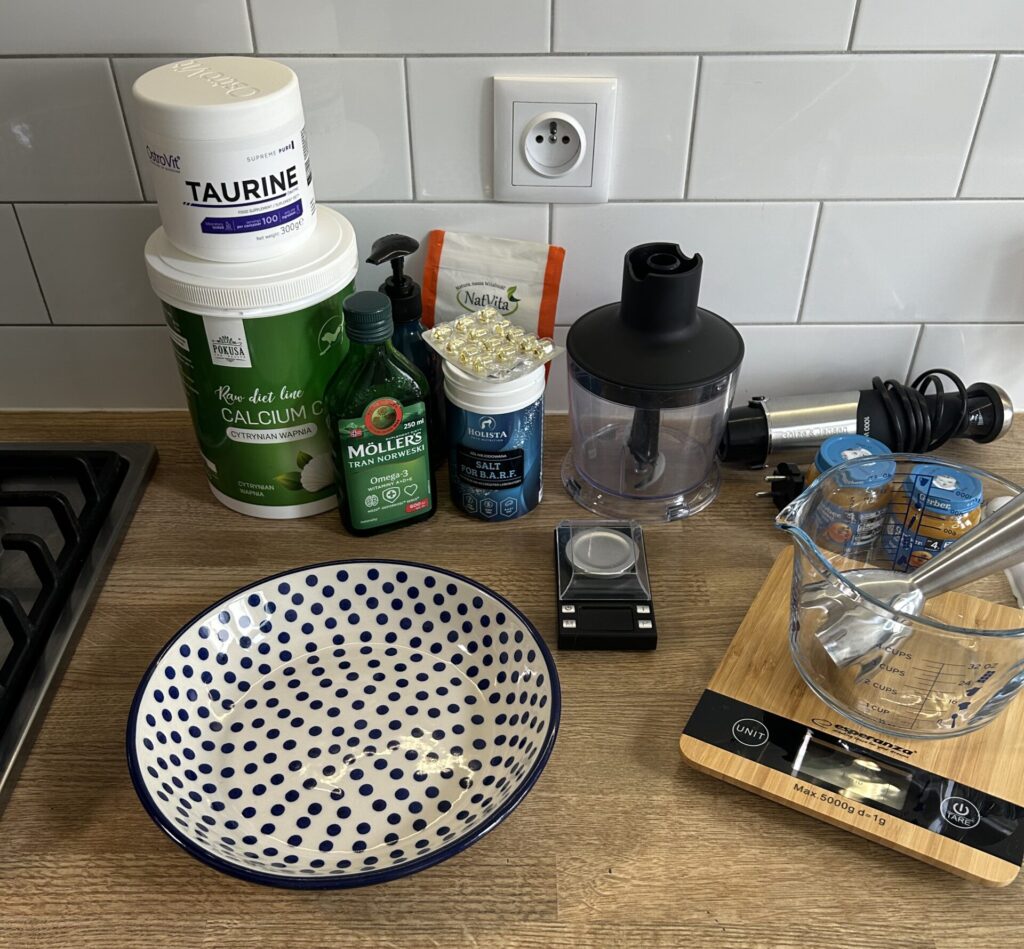
🔪 Essential kit
- A sharp knife and chopping board
- A blender — for blending supplements with water and chopping offal.
- Kitchen and jewellery scales (precise measurement of supplements is important).
- Containers/jars/freezer bags for freezing daily portions.
- Recipes from meatpoint.io or other trustworthy source compliant with the current state of science. A recipe must always be balanced!
🧤 Things that are useful but not essential
- Meat mincer
- Gloves/face mask if you find handling meat and strong smells difficult
✅ Practical tips
- You can chop or mince the ingredients; offal can easily be blended in a food processor. For cats, some of the ingredients should be minced so that the supplements are evenly distributed throughout the mixture.
- It’s worth asking the shop to mince your chosen piece of meat for you — it saves a lot of time and effort.
- You can buy vegetables in the form of baby food purées, such as those in jars with a simple ingredient list, e.g. 100% pumpkin
- Ensure good hygiene and maintain the cold chain. Meat should go straight from the shop into the fridge and be used as soon as possible. If it has been defrosted, never refreeze it (unless you subject it to heat treatment, such as making BACF).
〰️ The process of changing one’s diet and the transition
The body needs a little time to get used to the new diet. Start by giving a few portions of meat, offal and vegetables a week — once you’ve mastered this stage, you can move on:
- Level I: If your dog or cat happily eats meat, offal and vegetables three times a week — the hardest part is behind you!
- Level II: Gradually introduce balanced mixes as the basis of their diet. Start with meat, offal, vegetables, taurine (🐈⬛for cats in the standard diet, and 🐕 for dogs in the BACF diet – click here for more on BACF), water, salt and calcium. Add each subsequent supplement weekly.
- Level III: Experiment with recipes and flavours — introduce changes slowly, especially for sensitive dogs and cats.
- The adaptation process can take up to 2 months — patience and observation are key. If anything concerns you, stop and look for information. You can ask us anything on our Facebook group
💊 Why is supplementation so important?
One of the most common myths about BARF is the belief that meat and offal alone are sufficient to make the diet complete. However, for a dog or cat’s diet to be truly balanced and safe, it is essential to supplement their meals with appropriate supplements.
Most supplements come in powder form, sometimes as capsules to be squeezed or poured out, or as drops. There are also oils, such as salmon oil. These are usually mixed with water, and this mixture is poured over the meat and offal, then mixed thoroughly.
- Meat and offal do not meet all the nutritional needs of dogs and cats.
- In the wild, animals eat their prey whole, including the bones, fur, digestive tract contents and blood. At home, we are unable to replicate this, so we must supplement their diet with the missing nutrients.
- A lack of supplementation leads to serious metabolic disorders, problems with bones, immunity and skin, and even kidney and heart disease.
At meatpoint.io, you can easily create your own supplement packs that reflect what you actually have at home. The initial cost of a starter pack is around EUR 50-70, but it lasts for several months, and the monthly cost of supplementation is just a few euros.
💊 Essential supplements in BARF
- Calcium — a key building block for bones and teeth. A proper balance with phosphorus prevents growth disorders and bone diseases. Eggshell meal or ready-made preparations, such as calcium carbonate, are most commonly used.
- Vitamin E — a powerful antioxidant, it protects cells and supports immunity, and is particularly important in a diet rich in fats and omega-3 fatty acids. It also acts as a natural fat preservative.
- Vitamins B — support the immune and nervous systems, the skin and metabolism. The best source is brewer’s yeast.
- Sodium — regulates water, electrolyte and acid-base balance. Most commonly administered in the form of rock salt or Himalayan salt.
- Omega-3 fatty acids — balance out excess omega-6, support healthy skin, coat and immunity, and have anti-inflammatory properties. Sources: salmon oil, cod liver oil, krill oil.
- Iodine — regulates normal thyroid function, most commonly supplemented using seaweed (Ascophyllum nodosum). Note: the iodine content in seaweed can vary – check the batch number on the packaging!
- Taurine — an essential amino acid for cats (and dogs on a cooked diet, i.e. BACF). It supports heart health, vision and the nervous system. It is best to choose pure taurine with no additives.
💊 Conditional and supplementary supplements
The supplements listed below won’t always appear in a recipe. Whether they’re included depends on who the recipe is for and what ingredients you’re using. It’s best to try the free demo version, add your pets and have a go at preparing a few recipes – that way you’ll know whether you need to buy these supplements.
- Iron — essential for haemoglobin production and the prevention of anaemia. Sufficient amounts are usually obtained from meat and offal, but additional supplementation (e.g. dried blood) is sometimes necessary.
- Phosphorus — important for young animals and sometimes required in weight-loss diets. In most recipes, meat covers the phosphorus requirement.
- Vitamin D — regulates calcium and phosphate metabolism. Natural sources include fish, eggs and liver, whilst cod liver oil is most commonly used for supplementation.
- Egg yolks — a natural multivitamin source containing biotin, niacin, choline, zinc, iron, vitamins A, D, E and K, and trace elements. If your pet is allergic to chicken eggs, you can omit them or choose eggs from other species. It is always worth adding them, though this is not mandatory.
- Copper and magnesium — introduced as needed, based on test results or as part of an elimination diet.
Remember: Supplementation isn’t just a fad, but a necessity in a BARF diet. It’s the only way to ensure your dog or cat gets everything they need for a healthy, long life.
You’re always asking us where the best place is to buy supplements, and the answer is simple — wherever it’s cheaper and more convenient. All the supplements on the list at meatpoint.io have been checked by our nutritionists and are products we can confidently recommend.
Thanks to our joint efforts with the dobrypan.pl shop, BARF supplement starter packs are now available at a great price with free delivery: 👉 https://dobrypan.pl/kategorie/top-marki/meatpointio (not in Poland? check with the shop if they ship to you location). Check whether this is everything you need, or if you need to add anything else (e.g. bone meal). Thanks to this collaborative partnership (yes — we’re not making any money from this 😀), you can buy everything in one place, including cheaper, top-quality alternatives such as ‘human-grade’ taurine, Kłodawska salt or Tokovit (those are Polish-market specific alternatives).
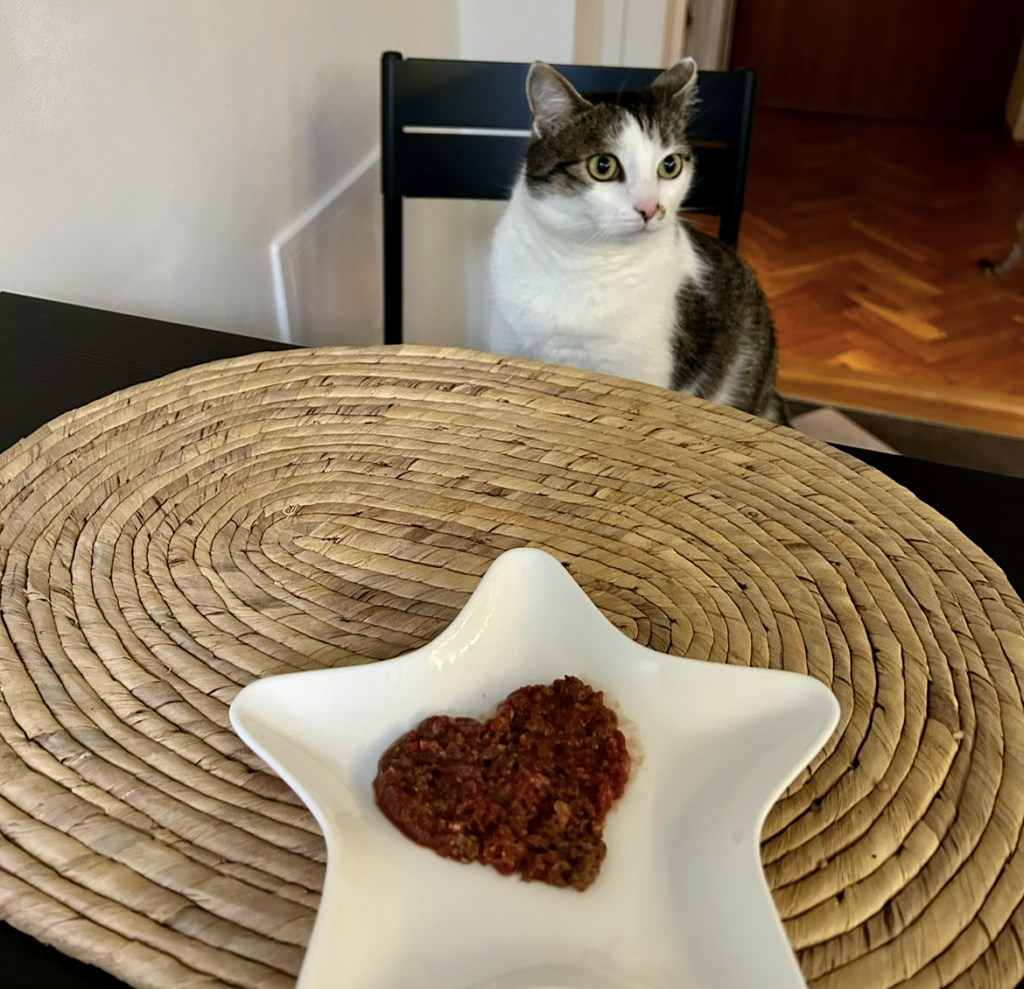
🍲 How should you feed BARF?
- Serve at room temperature — do not serve straight from the fridge or freezer.
- Portion out the food as per the recipe — if your dog or cat eats everything with gusto and doesn’t just pick out their favourite ingredients, the balance of the mixture is maintained.
🙅🏻♀️ Tips for fussy eaters
- Try out different types of meat and offal to tailor the flavour of the meals to your pet’s taste.
- Try out different textures — some dogs and cats prefer meat in chunks, others prefer minced meat. Texture plays a big part in palatability, and pets often prefer the familiar textures they’re used to from tinned food; if they like minced meat, stick with minced meat.
- If your pet is reluctant to try new things, introduce changes slowly and patiently.
- If your pet has trouble accepting supplements, start with very small amounts (e.g. a pinch of sprinkles) and gradually increase the dose to the amount specified in the recipe.
- If your pet has a more sensitive digestive system, it’s worth considering the easier-to-digest cooked version (BACF) – you’ll find preparation instructions in the article “BACF, or cooked BARF – a step-by-step guide”
📔 Storage and planning
- It’s best to plan your BARF shopping trips to coincide with your own.
- Think about what’s available locally. You’ll be doing this often, so make life easier for yourself.
- It’s best to choose meat in chunks, not minced. That way, you can see what the piece looks like and whether it’s fresh. However, you can ask the shop to mince it for you and save yourself the work at home.
- Stock up on some meat treats and toppings in case you ever need to enhance the flavour of a meal.
- In our cat and dog diet creator, we automatically select the percentage of offal and vegetables based on a short questionnaire. However, after changing your pet’s diet, you must monitor the quality of their stools and their bowel movement patterns. Offal and vegetables are responsible for their quality. If your pet defecates less frequently than every 48 hours or has difficulty passing stools, consider increasing the proportion of offal and/or adding vegetables.
‼ Remember
- At meatpoint.io, you can’t go wrong with a recipe – the algorithm doesn’t allow any that aren’t suitable. This means that every recipe you see is safe to feed to your dog or cat.
- Start with simple steps, don’t be afraid to ask questions, and learn from the experiences of other pet owners.
- Every dog and cat can eat healthily — all it takes is a little willingness and a positive attitude.
- If in doubt, consult us, a nutritionist or a vet.
👥 Join the meatpoint.io community!
You’re not alone on your BARF journey! Join the active Facebook group “meatpoint.io BARF for dogs and cats” — it’s a place to share experiences, practical advice and support from other pet owners. There you’ll find inspiration, the latest news and answers to questions that arise at every stage of the BARF diet.
Click to join: https://www.facebook.com/groups/meatpoint.io! The content here is mostly in Polish, but feel free to post in English — the admins speak fluent English.
🎥 See how it works in practice!
Theory is one thing, but it’s often the practical side that raises the most questions. If you want to see what preparing a homemade BARF diet really involves — from choosing ingredients to portioning and supplementation — be sure to watch our video guide!
👉 Watch the video “BARF in 6 minutes! A quick, stress-free start!” (in Polish) on our YouTube channel and use the calculator, ask questions, join the community and feed your pet sensibly!